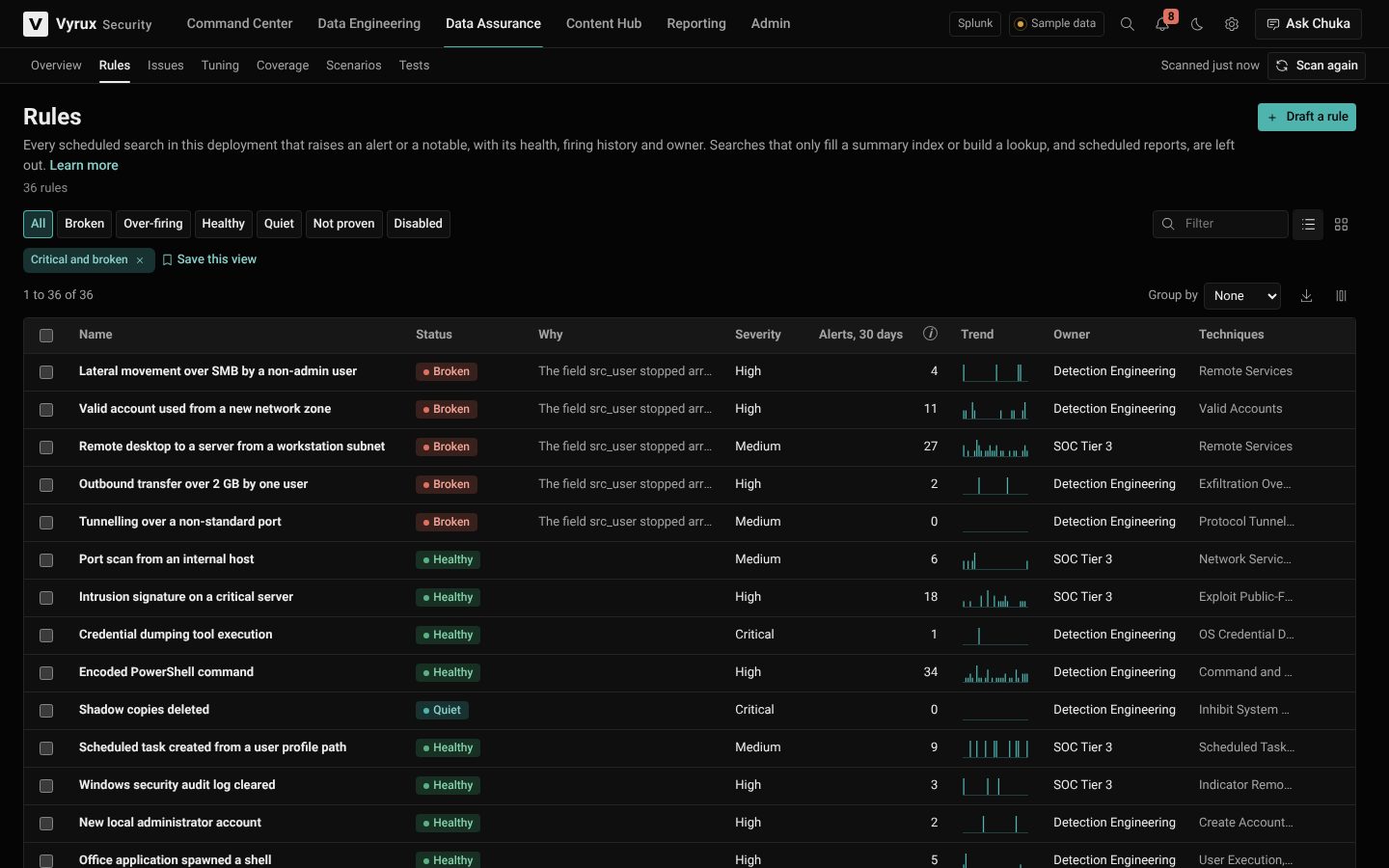
Rules
Every scheduled correlation search found in this deployment, with its health, firing history and owner. Reports and lookup-building searches are left out.
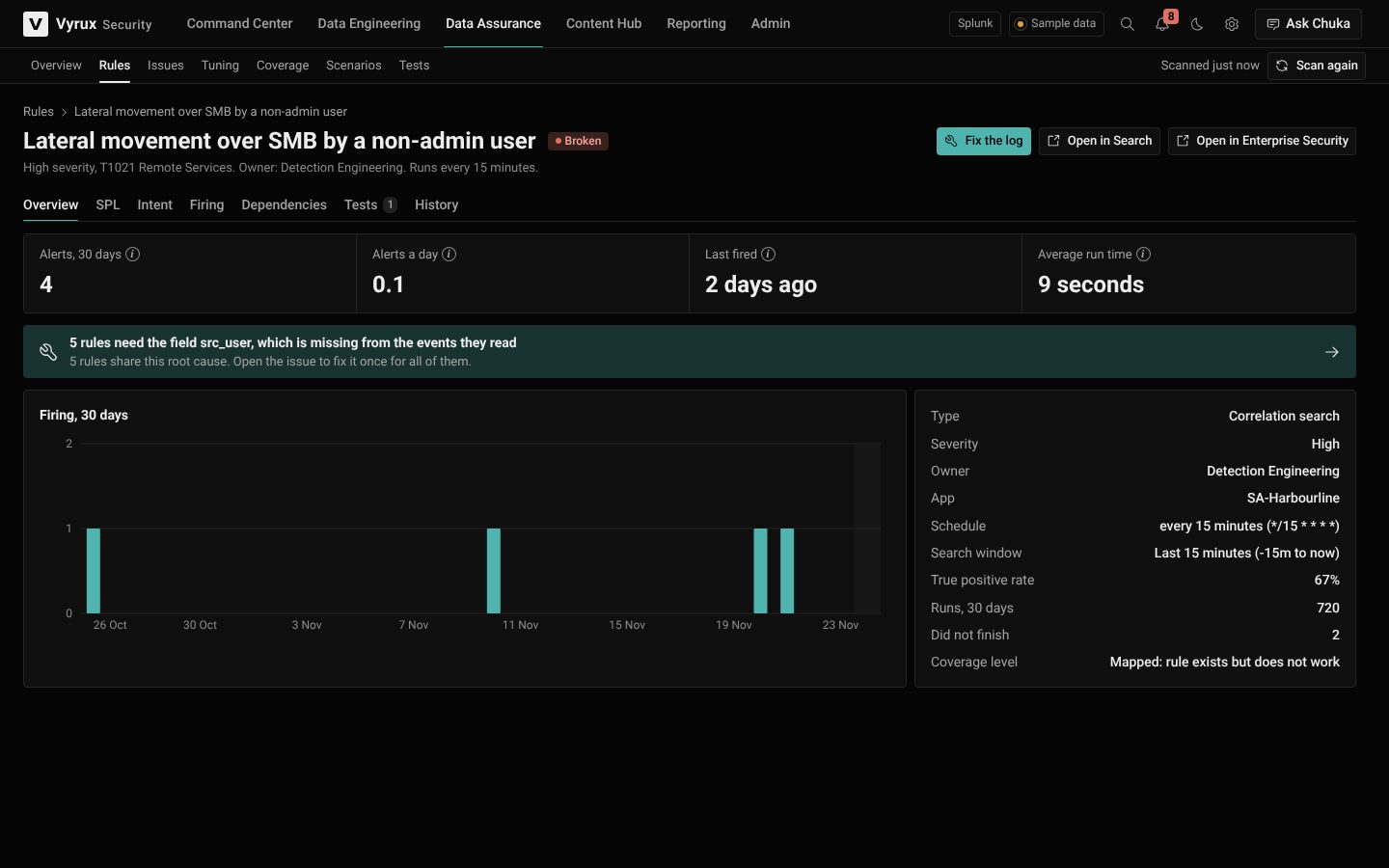
Open a rule to see everything about it:
| Overview | Alerts, alerts a day, when it last fired, average run time, schedule and search window |
| SPL | The search, with each part explained |
| Intent | What the rule is meant to detect, and whether every value its search looks for agrees, with how Splunk proved each mismatch. Chuka's own review is below it |
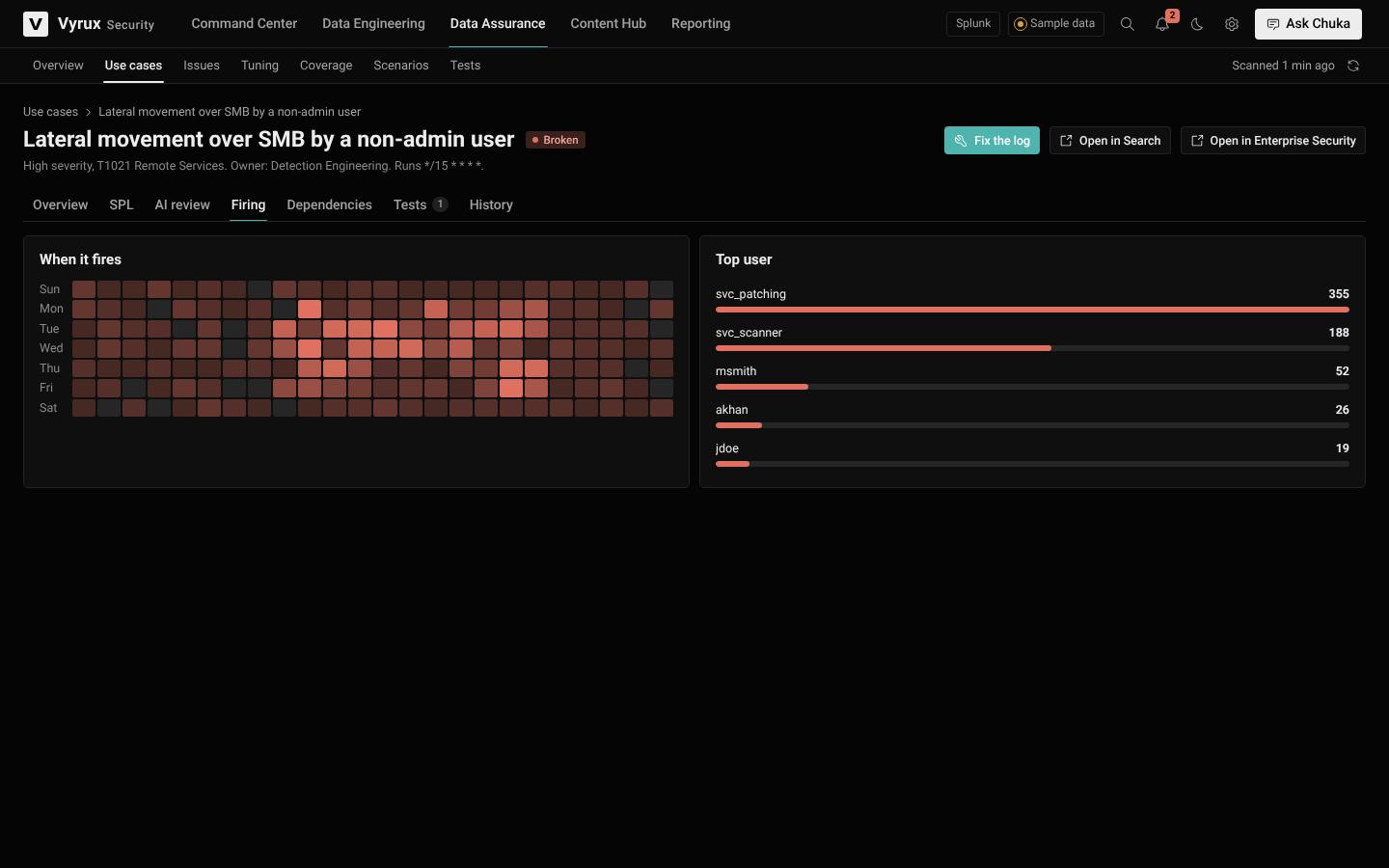
| Firing | When it fires by day and hour, and who causes the alerts |
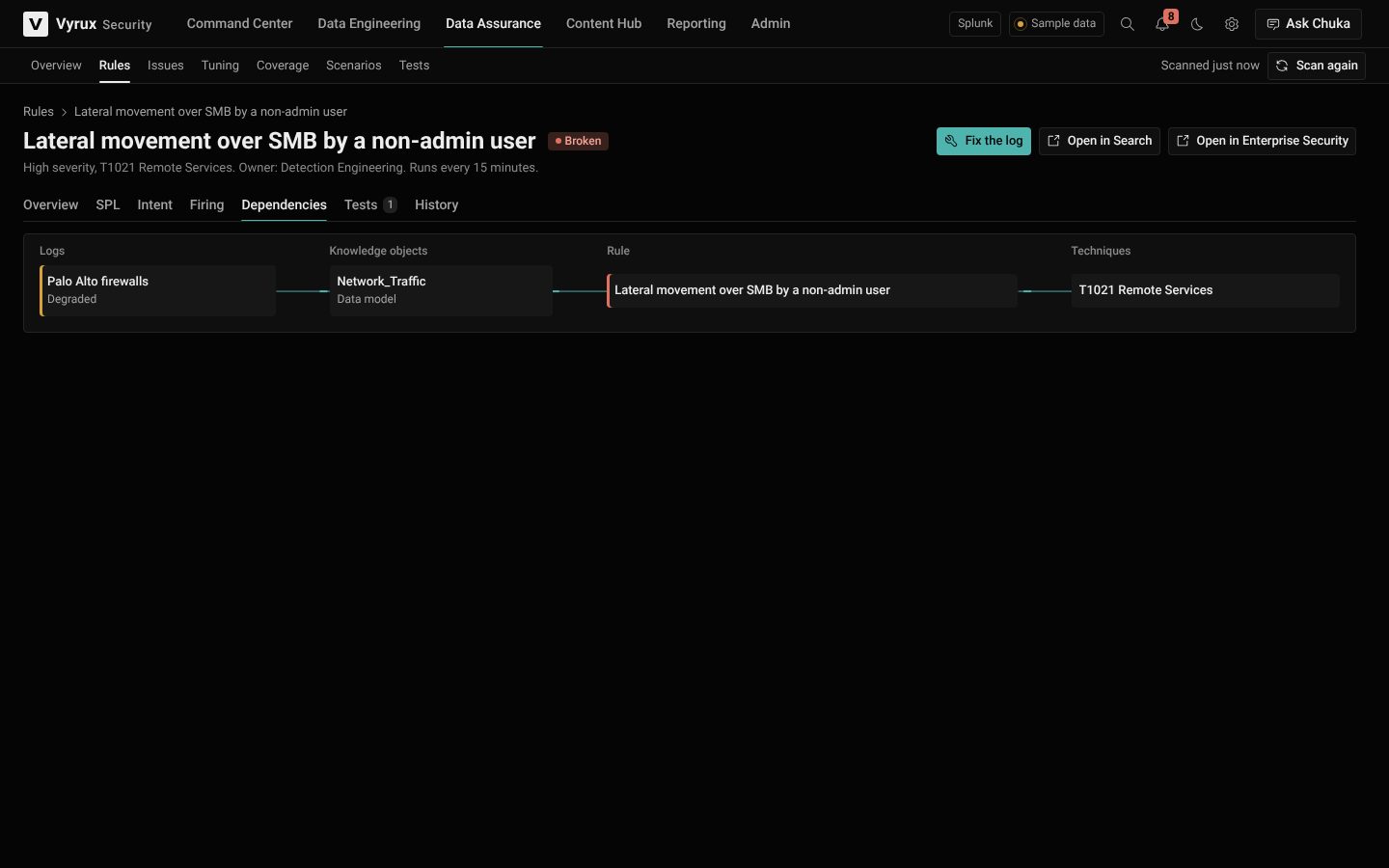
| Dependencies | The logs, data models, macros and lookups it needs |
| Tests | Dry runs, replays and attack simulations |
| History | Every change made to it through Vyrux |
Does each rule look for what it is meant to detect?
A rule can run, match events and alert, and still watch the wrong thing. A rule named for failed sign-ins that looks for EventCode=4624 alerts on every successful sign-in and never on an attack. Vyrux checks this for every enabled rule, at every background scan, in three steps.
- What the rule is meant to detect is read from its own name (an Enterprise Security name such as Access - Excessive Failed Logins - Rule is read without its domain and the word Rule), or a short description, where an outcome stands next to what it is about: failed logins, connections blocked, user accounts deleted. Every other word must be a neutral one (excessive, multiple, windows, user) or a rule number: a name such as Invalid logon type for service account or Login failure lockout cleared says something else and is not judged. A rule about a sequence of events (successful login after brute force, failed logins followed by success), or one whose words name a second outcome anywhere (multiple failed logins with a success, account created and deleted, successful login blocked user), has no single intent and is not judged. Neither is a search that asks for both outcomes on purpose (
EventCode=4625 OR EventCode=4624, or a vendor's own spelling of the intended outcome in an outcome field such asstatus=failure,result=unsuccessfuloraction=drop), anywhere in it: a latersearchorwhere, a subsearch, ajoinor anappend. A word for any outcome other than the one the value judged means, anywhere in the search, in a lookup, a summary source, a field name or a value (recent_failed_logins,failed_login_summary,fails,reason=denied), means the rule reaches its outcome another way, and the rule is not judged. Words that name a list (block list, allow list, deny list) or negate an outcome (non-failed) say no outcome. Values are read from the base search, latersearchandwherecommands, thewhereclause oftstats(data model fields such asAuthentication.actionincluded) and every subsearch. - What each value means is read from Splunk's Common Information Model (the
actionfield) and from Microsoft's documentation of Windows security audit events. - Each mismatch is tested on the rule's own events. Vyrux runs the rule's own search, up to its first command that is not a filter. For a value such as
EventCode=4624it keeps the events with that value and counts them by theiractionfield; when most of them carry the opposite outcome, the mismatch is a problem, reported with the count: high when none of the events carry the intended outcome, medium when some do. For a value ofactionitself, counting byactionwould only restate it, so Vyrux counts the same logs without that one condition: the mismatch is a problem when at least 10 events, and at least 5 percent of those logs, carry the intended outcome and the rule keeps only the other. A rule whose search narrows its events before the count (asearch,where,regex,lookupordedup, or anevalthat sets the field judged) or goes on to alookup,join,append,union,transactionor a subsearch is not judged, because those choose events the count cannot see. Otherwise nothing is reported: when the events carry the intended outcome the mismatch is dropped, and when they cannot confirm it (noactionfield, no events, atstatssearch, a macro Vyrux cannot read) it is listed on the rule's Intent tab as worth a look.
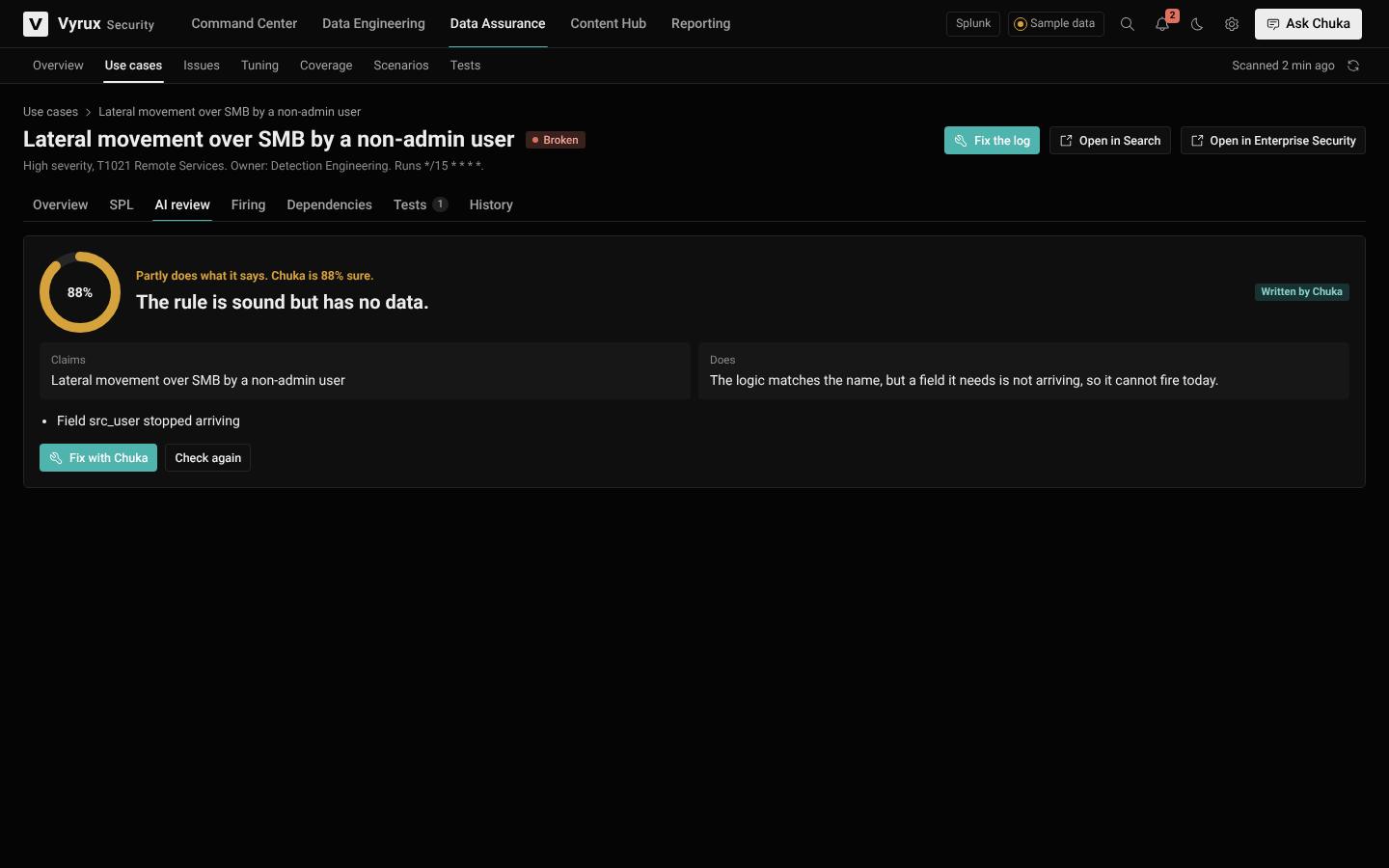
When a Vyrux admin turns it on under Admin, AI, Review rules with AI, Chuka also reviews new versions of rules' searches, a few at each background scan, at most 40 a day and never more than a tenth of the month's AI credits, and may say what a rule seems to be for and which value looks wrong. Vyrux counts each suggestion in the rule's data the same way and shows it on the rule's Intent tab as the AI's view, with what the data showed. A suggestion is never reported as a problem: a count of one field by its action ignores the rule's other conditions, so only the deterministic check above reports. It is off unless turned on.
A proved mismatch opens an issue in Vyrux with every rule that shares it. The rule still fires, so it is not counted as unable to fire; it fires on the wrong events. The issue is not sent to your ticketing or chat tools: a review of what a rule looks for is work for its author, not an alert.